Search the web for "how to remove AI tags," and you will find an ocean of conflicting claims. Some shady blogs swear that screenshotting an image bypasses everything; other tools make grandiose claims about "completely destroying all AI tracking forever."
As with most engineering challenges, the reality is nuanced. Different artificial intelligence platforms employ completely different tracking architectures.
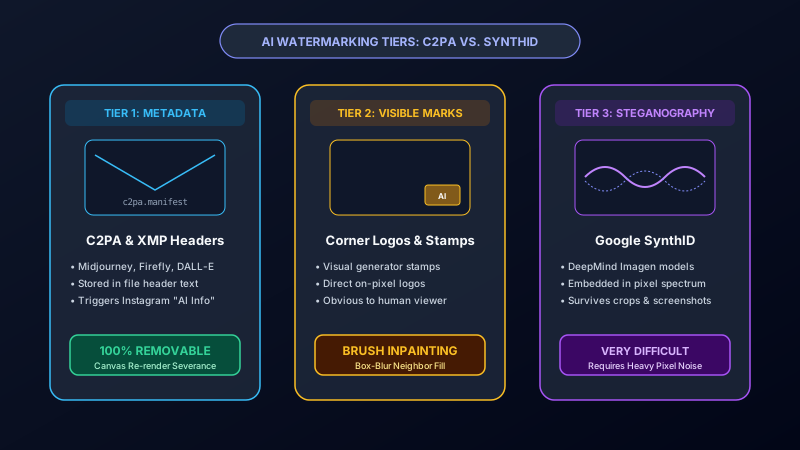
The Three Tiers of AI Watermarking
To understand what can and cannot be removed, you must evaluate image provenance on three distinct layers:
| Watermark Tier | Storage Location | Used By | Removability Status |
|---|---|---|---|
| Tier 1: Metadata | File header (JUMBF / XMP) | Midjourney, Firefly, DALL-E, Meta | ✓ 100% Removable |
| Tier 2: Visible Marks | Visible pixels (Corner logos) | DALL-E 2, Stock generators | ✓ Removable via Inpainting |
| Tier 3: Steganography | Pixel frequency harmonics | Google DeepMind (SynthID) | ~ Extremely Difficult |
Tier 1: C2PA & XMP Metadata (100% Removable)
What it is: Cryptographic manifests and metadata tags written into the binary envelope of the file.
This is the mechanism used by the vast majority of commercial generators—including Adobe Firefly, Midjourney v6, and OpenAI's DALL-E 3 API. It is also the sole trigger for automated "AI Info" badges on Instagram, TikTok, and Facebook.
Can it be removed? Yes, completely. Because metadata lives in file headers rather than in the visual pixels, drawing the image onto an HTML5 canvas and re-exporting it strips 100% of the C2PA chain without altering visual image quality.
Tier 2: Visible Corner Watermarks (Inpainting Removable)
What it is: Physical emblems, colored bars, or logo stamps burned directly into the image canvas.
Because these marks occupy visual pixels, metadata stripping alone cannot remove them. However, they can be erased using localized box-blur inpainting:
- The user brushes over the watermark area.
- The algorithm masks those coordinates and samples adjacent pixels to blend the surrounding color and texture into the erased region.
This capability is built directly into Remove AI Label's interactive eraser canvas.
Tier 3: Google SynthID (Deep Steganography)
What it is: A breakthrough watermarking technology developed by Google DeepMind and deployed in Imagen 3 and Google Gemini.
Unlike metadata, SynthID does not store records in headers. Instead, during image generation, the neural network embeds a subtle mathematical wave pattern directly across the frequency spectrum of the pixels.
Technical Truth: Beware of False Claims
Any website claiming it can "100% erase Google SynthID with one click" without heavily blurring or ruining the picture is misrepresenting its capabilities. SynthID was specifically engineered to survive screenshots, cropping, lossy JPEG compression, and minor color grading.
Clean Your File Headers & Disrupt AI Scanners
Wipe C2PA credentials, remove visible corner watermarks, and apply anti-classifier pixel noise locally in your browser.
Launch Metadata CleanerHow Pixel Perturbation Confounds Naive Classifiers
While deep mathematical steganography like SynthID requires heavy distortion to break, many third-party AI detectors (such as Hive AI, Illuminarty, or AI or Not) do not check for SynthID. Instead, they look for:
- Unusually smooth skin gradients typical of latent diffusion.
- Repeating mathematical artifacts in high-frequency pixel channels.
To disrupt these statistical classifiers without reducing visible quality, Remove AI Label injects a micro-perturbation layer—randomizing pixel RGB values by $\pm 3$ values. This introduces optical noise that fragments synthetic frequency patterns while remaining completely imperceptible to the human eye.
The Honest Verdict: What Works in Practice
For content creators publishing on Instagram, TikTok, Facebook, Pinterest, or Etsy:
- 99% of automated platform labels are triggered exclusively by Tier 1 metadata (C2PA/XMP).
- Removing this metadata using client-side canvas re-rendering completely prevents automated "AI Info" tagging.
- By combining clean metadata severance with subtle pixel perturbation, you protect your content reach safely and ethically.