If you sell printable wall art, digital templates, stickers, or print-on-demand merchandise on Etsy, Shopify, or Pinterest, organic search discovery is the engine of your business.
Recently, however, an alarming trend has emerged across creator forums: sellers are experiencing sudden, precipitous drops in shop visits, impressions, and sales rankings after uploading fresh design batches.
Why Marketplaces Are Restricting Raw AI Uploads
Online marketplaces are engaged in a fierce battle against automated spam. When low-quality accounts upload tens of thousands of raw, uncurated AI renders daily, the shopping experience suffers. In response, platforms have updated their algorithms to favor human-curated and bespoke products.
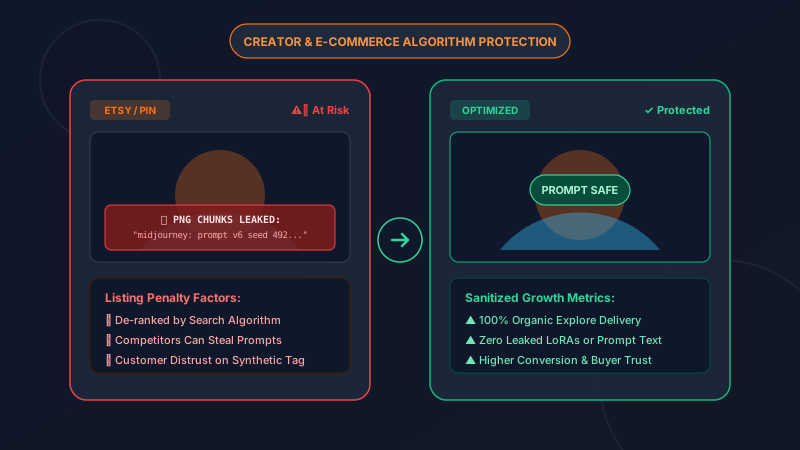
To automate this sorting, platforms scan the metadata headers of uploaded product photography. When an image contains traces of pure AI generation, automated recommendation systems may:
- Exclude listings from high-converting "Trending" and "Editor's Picks" feeds.
- Throttle visual search recommendations on Pinterest.
- Attach synthetic disclosure warnings that drastically decrease buyer conversion rates.
The Hidden Vulnerability: Prompt Leakage in PNG Chunks
Beyond platform penalties, an even greater commercial risk awaits creators who upload raw files: intellectual property theft.
When you download an image from Midjourney, NovelAI, or ComfyUI/Stable Diffusion, the software stores generation details in hidden binary sections known as `tEXt` and `iTXt` chunks:
{
  "generator": "Stable Diffusion WebUI",
  "prompt": "boho minimalist wall art, earthy tones, terracotta arches, gouache texture, 8k",
  "negative_prompt": "blurry, low quality, oversaturated",
  "sampler": "Euler a",
  "seed": 892019482,
  "model": "analog_diffusion_v3"
}
If you use these raw files as listing mockups or downloadable customer deliverables, any competitor can right-click, save your image, inspect the metadata, and recreate your entire product line in seconds.
Protect Your Trade Secrets
Prompt engineering and custom workflow configurations represent dozens of hours of creative trial and error. Never share raw generation files that broadcast your exact prompts and model configurations.
Platform Breakdown: Etsy, Pinterest, & TikTok Shop
| Platform | Scanning Method | Risk of Untreated AI Metadata |
|---|---|---|
| Etsy | File header analysis & "Creativity Policy" audits | Reduced organic search placement, listing reviews |
| Visual hash classification & C2PA checks | Suppression on Home Feed & Related Pins | |
| TikTok Shop | Automated metadata & watermark crawlers | Loss of FYP showcase eligibility |
Sanitize Product Listings Before Publishing
Wipe Midjourney prompt chunks, C2PA manifests, and generator fingerprints in seconds with our free in-browser scrubber.
Scrub My Product ImagesThe 3-Step Image Sanitization Protocol for Sellers
To protect your shop's revenue and avoid algorithmic de-prioritization, implement this pre-upload routine:
- Scrub Generator Metadata: Run all mockup pictures through Remove AI Label to permanently discard all `tEXt` chunks, XMP strings, and C2PA markers.
- Erase Visible Watermarks: If any generative tool leaves tiny corner emblems or artifacts, brush over them using the built-in inpainting tool.
- Apply Micro-Noise Perturbation: Remove AI Label subtly randomizes pixel RGB values by $\pm 3$, defeating automated visual hash crawlers that target repetitive diffusion noise patterns.
Preserving Buyer Trust & Conversion Rates
Customers buy artwork and designs for their beauty, emotional resonance, and uniqueness. When an online platform forces an alarming "Synthetic Content" label onto a listing, buyers second-guess their purchase.
By publishing clean, fully curated assets, you ensure your listings are judged on their visual merit and creative curation—not on automated technical markers.